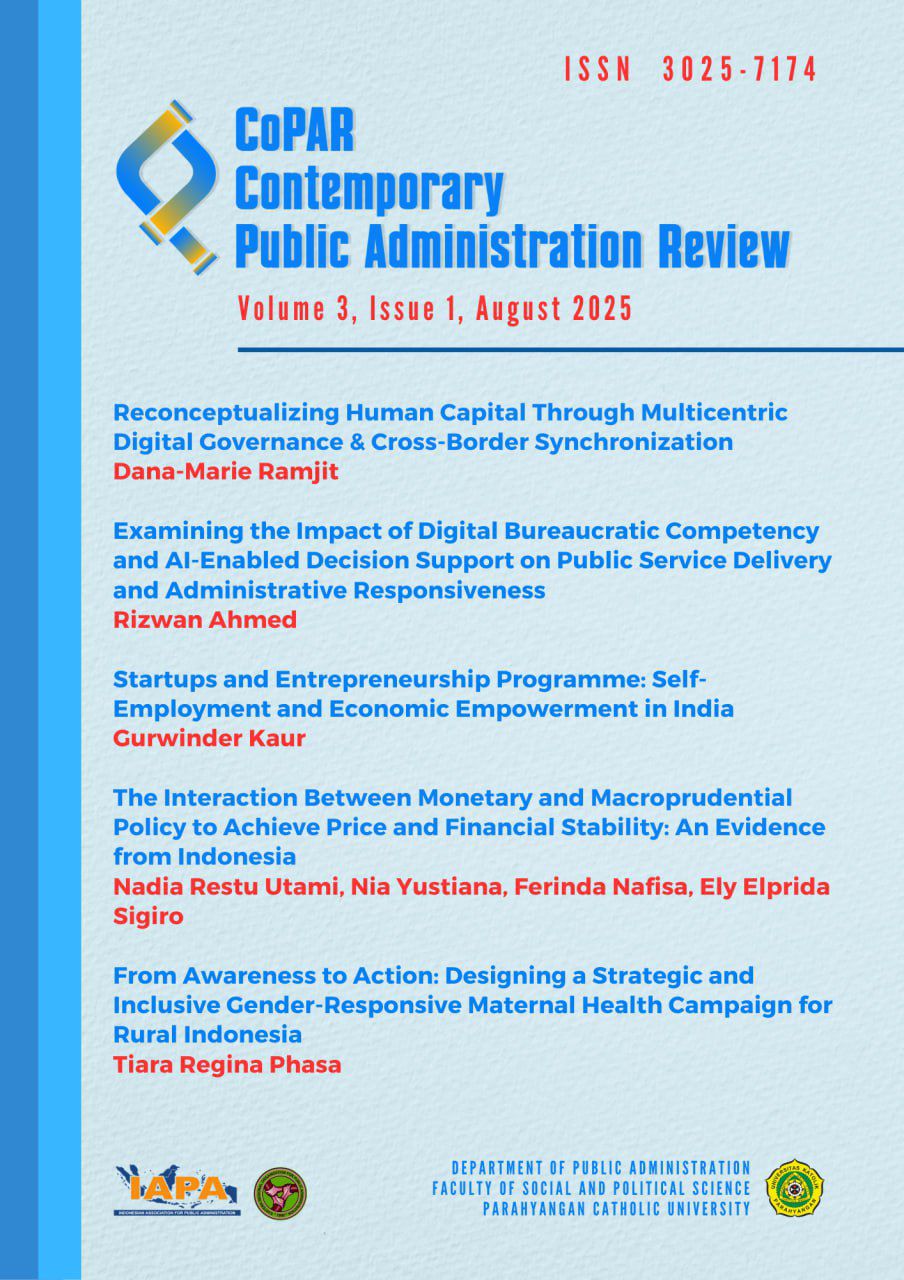
From Awareness to Action: Designing a Strategic and Inclusive Gender-Responsive Maternal Health Campaign for Rural Indonesia
DOI:
https://doi.org/10.26593/copar.v3i1.9615Keywords:
Gender-Transformative Advocacy, Maternal Health, Public Health Policy, Strategic Communication, TARES FrameworkAbstract
This article outlines a strategic maternal health campaign designed for rural Indonesia, addressing persistent gender-based barriers and inequalities in healthcare access. Based on Mahoney’s strategic communication planning model and assessed using the Truthfulness, Authenticity, Respect, Equity, and Social Responsibility (TARES) ethical persuasion framework, the campaign incorporates culturally meaningful narratives and participatory advocacy to encourage safe maternal practices. It aims to address Indonesia’s high maternal mortality rates, especially in remote areas, by connecting traditional birthing customs with modern medical care and fostering collaboration between midwives and traditional birth attendants. The campaign employs social movement framing theory to galvanise community support, utilising storytelling, local media, and interpersonal communication to engage various stakeholders, including religious leaders, village health workers, and family decision-makers. Based on gender and development theory, the study emphasises how decentralisation and strong social norms limit women’s independence and access to skilled care. It employs strategic messaging and inclusive methods, such as mobile health clinics, community posters, and village discussions to address structural and cultural obstacles. Ethical issues related to informed consent and narrative influence are addressed through respectful and honest communication. The article also encourages higher service utilisation, greater trust in midwives, and increased community engagement. This campaign provides an approach that can be replicated for ethical, gender-focused maternal health advocacy in low-resource areas, aiding Indonesia in achieving Sustainable Development Goal 3.1.
References
Agus, Y., Horiuchi, S., & Ilida, M. (2018). Women’s choice of maternal healthcare in Parung, West Java, Indonesia: Midwife versus traditional birth attendant. Women and Birth, 31(6), 513–519. https://doi.org/https://doi.org/10.1016/j.wombi.2018.01.007
Analen, C. (2007). Saving mother ’s lives in rural Indonesia. Bulletin of the World Health Organization, 85(10), 740–741. https://doi.org/10.2471/BLT.07.031007
Aryastami, N. K., & Mubasyiroh, R. (2021). Traditional practices influencing the use of maternal health care services in Indonesia. PLoS ONE, 16(9), 1–14. https://doi.org/10.1371/journal.pone.0257032
Baker, S., & Martinson, D. L. (2001). The TARES Test: Five Principles for Ethical Persuasion. Journal of Mass Media Ethics, 16(2–3), 148–175. https://doi.org/https://doi.org/10.1080/08900523.2001.9679610
Benford, R. D., & Snow, D. A. (2000). Framing Processes and Social Movements: An Overview and Assessment. Annual Review of Sociology, 26(1), 611–639. https://doi.org/https://doi.org/10.1146/annurev.soc.26.1.611
Delporte, M., Hurst, B., Bartlett, J., & Hatcher, C. (2023). Making Sense of Human Advocacy Narrative: Raising Support for People Seeking Asylum Among Diverse Audiences. International Journal of Communication, 17, 947–970. https://eprints.qut.edu.au/244432/
Duong, H. T., Vu, H. T., & Nguyen, N. (2019). Activists’ Strategic Communication in an Authoritarian Setting: Integrating Social Movement Framing into Issues Management. International Journal of Strategic Communication, 13(2), 133–151. https://doi.org/https://doi.org/10.1080/1553118X.2019.1590366
Indonesian Central Statistics Agency (Badan Pusat Statistik Indonesia). (2023). Angka Kematian Ibu/AKI (Maternal Mortality Rate/MMR) Hasil Long Form SP2020 Menurut Provinsi Tahun 2020. https://www.bps.go.id/id/statistics- table/1/MjIxOSMx/angka-kematian-ibu-aki-maternal-mortality-rate-mmr-hasil-long-form-sp2020-menurut-provinsi-2020.html
Indonesian Central Statistics Agency (Badan Pusat Statistik Indonesia). (2024). Profil Kesehatan Ibu dan Anak Tahun 2024 (Vol. 10). https://www.bps.go.id/id/publication/2024/12/31/a919c55a72b74e33d011b0dc/pr ofil-kesehatan-ibu-dan-anak-2024.html
Indonesian Ministry of Health (Kementerian Kesehatan Republik Indonesia). (2020). Profil Kesehatan Indonesia Tahun 2019. Indonesian Ministry of Health (Kementerian Kesehatan Republik Indonesia). https://kemkes.go.id/id/profil-kesehatan- indonesia-2019
Indonesian Ministry of Health (Kementerian Kesehatan Republik Indonesia). (2023). Buku KIA (Kesehatan Ibu dan Anak). Indonesian Ministry of Health (Kementerian Kesehatan Republik Indonesia). https://ayosehat.kemkes.go.id/buku-kia- kesehatan-ibu-dan-anak
Indonesian UNFPA. (2022). Annual Report 2022. In Indonesian UNFPA. https://doi.org/10.5840/teachphil20113417
Indonesian UNICEF. (2024). A Lifesaving Legacy for Children in East Nusa Tenggara. Indonesian UNICEF. https://www.unicef.org/indonesia/stories/lifesaving- legacy-children-east-nusa-tenggara
Khumaira, Wahiduddin, Maria, I. L., Ansariadi, Darmawansyah, & Moedjiono, A. I. (2024). The Landscape of Maternal Health Service in Indonesia: A Narrative Review of Antenatal and Postnatal Services. Pakistan Journal of Life and Social Sciences (PJLSS), 22(2), 15854–15861. https://doi.org/10.57239/pjlss-2024-22.2.001149
Kim, M. D. (2022). Advocating “Refugees” for Social Justice: Questioning Victimhood and Voice in NGOs’ Use of Twitter. International Journal of Communication, 16(21), 719–739. https://ijoc.org/index.php/ijoc/article/view/17116
Leung, C. (2024). Midwifery and Maternal Health in Indonesia. Brown Undergraduate Journal of Public Health, 3.https://sites.brown.edu/publichealthjournal/2024/03/15/midwifery-and- maternal-health-in-indonesia/
Mahoney, J. (2023). Strategic Communication: Campaign Planning (3rd ed.). Routledge. https://doi.org/https://doi.org/10.4324/9781003317579
Martin, G. (2015). Understanding Social Movements (1st ed.). Routledge. https://doi.org/https://doi.org/10.4324/9780203837092
Mellinger, M. S. (2014). Beyond Legislative Advocacy: Exploring Agency, Legal, and Community Advocacy. Journal of Policy Practice, 13(1), 45–58. https://doi.org/https://doi.org/10.1080/15588742.2013.855887
Muhidin, S., Prasodjo, R., Silalahi, M., & Pardosi, J. F. (2018). Community Engagement in Maternal and Newborn Health in Eastern Indonesia. In M. Withers & J. McCool (Eds.), Global Health Leadership: Case Studies From the Asia-Pacific (pp. 67–78). Springer Nature Swiderland. https://doi.org/https://doi.org/10.1007/978-3-319- 95633-6
Plaisance, P. L. (2009). Media Ethics: Key Principles for Responsible Practice. SAGE Publications Inc.
Purba, H. J., Rachmawati, R. R., Irawan, A. R., Rola-Rubzen, M. F., Sudaryanto, T., Erwidodo, E., Dermoredjo, S. K., & Yaumidin, U. K. (2025). Linkages Between
Gender and Rural Transformation in Indonesia. Asia and the Pacific Policy Studies, 12(2), 1–11. https://doi.org/10.1002/app5.70027
Siagian, M. (2023). Maternal Mortality Rate Reduction Program Implementation During The Coronavirus Diseases 19 Pandemic in West Java Province. Contemporary Public Administration Review, 1(1), 46–58. https://doi.org/10.26593/copar.v1i1.6906.46-58
Syairaji, M., Nurdiati, D. S., Wiratama, B. S., Prüst, Z. D., Bloemenkamp, K. W. ., & Verschueren, K. J. . (2024). Trends and causes of maternal mortality in Indonesia: a systematic review. BMC Pregnancy and Childbirth, 24(1), 1–14. https://doi.org/10.1186/s12884-024-06687-6
Tempo.com. (2025). Indonesia, UK, and UNFPA Collaborate to Reduce Maternal Deaths. Tempo.Com. https://en.tempo.co/read/1986063/indonesia-uk-and-unfpa- collaborate-to-reduce-maternal-deaths
Titaley, C. R., Hunter, C. L., Dibley, M. J., & Heywood, P. (2010). Why do some women still prefer traditional birth attendants and home delivery?: A qualitative study on delivery care services in West Java Province, Indonesia. BMC Pregnancy and Childbirth, 10(43). https://doi.org/10.1186/1471-2393-10-43
Triratnawati, A., & Izdiha, A. (2018). Family Intervention in The Problem of Maternal Death: A Case Study of Pregnant Women in Mbojo, Bima, West Nusa Tenggara. Jurnal Humaniora, 30(3), 263–270. https://doi.org/10.22146/jh.v30i3.36682
World Health Organization. (2025a). Healthy beginnings, hopeful futures: How Indonesia’s commitment to maternal and child health is changing lives. World Health Organization. https://www.who.int/indonesia/news/detail/07-04-2025-healthy- beginnings--hopeful-futures--how-indonesia-s-commitment-to-maternal-and- child-health-is-changing-lives
World Health Organization. (2025b). Maternal mortality ratio (per 100 000 live births). World Health Organization. https://data.who.int/indicators/i/C071DCB/AC597B1
Yusran, S., Thomas, D., Matoka, U., & Mokodompit, E. (2019). Unequal Access to Maternal and Neonatal Health in Indonesia with Gender Perspective. International Conference on Environmental Awareness for Sustainable Development in Conjunction with International Conference on Challenge and Opportunities Sustainable Environmental Development, ICEASD & ICCOSED, 1–6. https://doi.org/10.4108/eai.1-4-2019.2287202
Downloads
Published
Issue
Section
License
Copyright (c) 2025 Tiara Regina Phasa

This work is licensed under a Creative Commons Attribution-ShareAlike 4.0 International License.