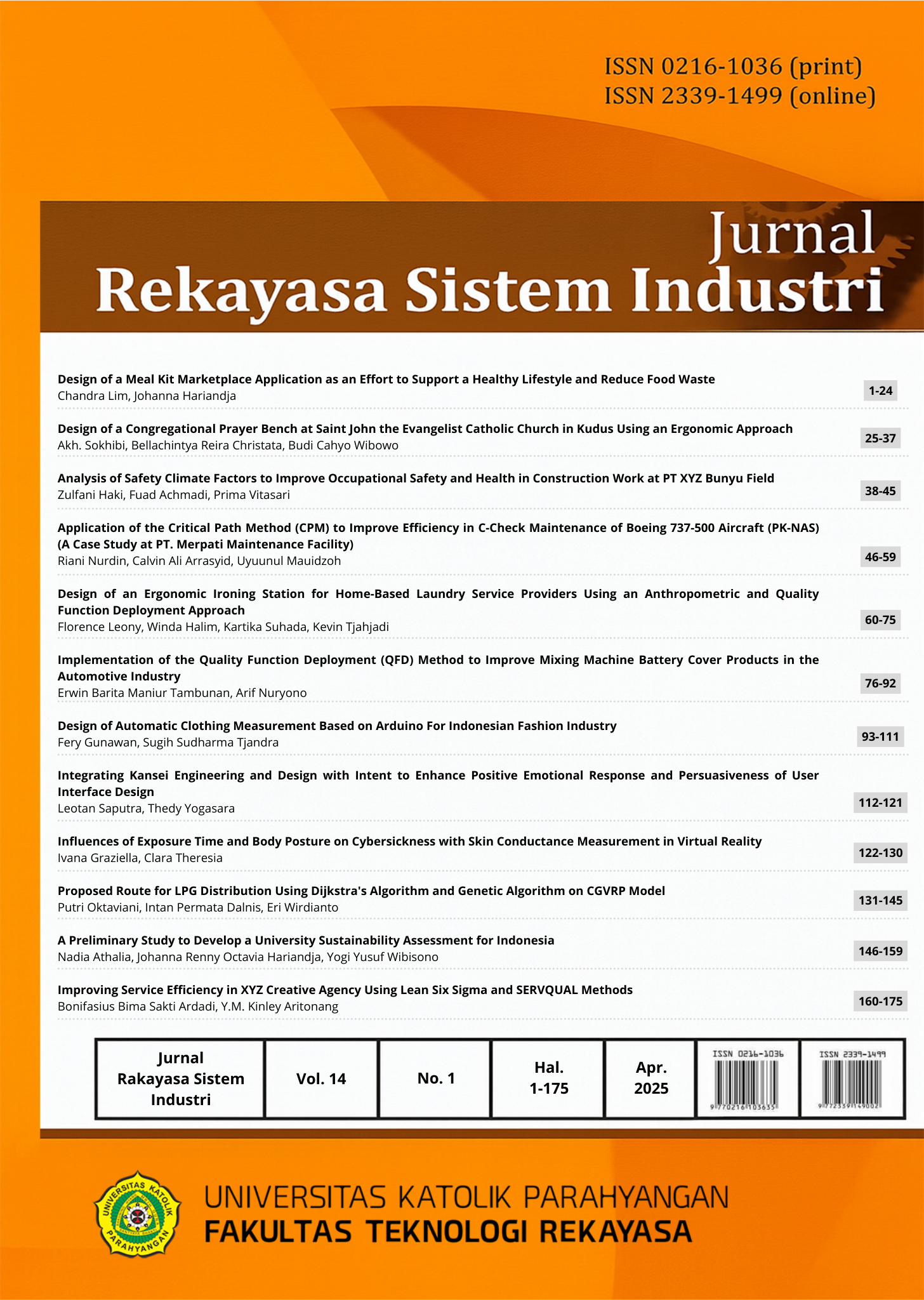
Application of the Critical Path Method (CPM) to Improve Efficiency in C-Check Maintenance of Boeing 737-500 Aircraft (PK-NAS) (A Case Study at PT. Merpati Maintenance Facility)
DOI:
https://doi.org/10.26593/jrsi.v14i1.7861.46-59Keywords:
Aircraft Maintenance, Efficiency, Turn Around Time (TAT), Critical Path Method (CPM), C-Check Maintenance, PT Merpati Maintenance Facility (MMF)Abstract
Turn Around Time (TAT) in C-Check maintenance activities is a problem that often occurs in aircraft maintenance service organizations because it requires large operational costs for technicians, and there are losses due to waiting time for aircraft operations during maintenance. This research compares company TAT with TAT using the Critical Path Method (CPM) and the percentage of man-hours efficiency from calculating the CPM method. The research object and data were collected at the PT Merpati Maintenance Facility. The types and sources of data used in research are primary and secondary. The data analysis techniques used are Turn Around Time (TAT) planning calculations and the Critical Path Method (CPM) method, as well as analyzing calculations that have been carried out using Microsoft Excel. Based on the research results, it was found that the difference in results between company planning was 18.56 or 19 work days and planning using the CPM method was 16.94 or 17 work days, so that you get more efficient time for 2 work days in carrying out C-Check maintenance with a percentage of the man hours efficiency formula of 0.087%.
References
Adhi, M. L., Adyanto, T. W., Irfansyah, A., Teknik, J., Udara, P., Surabaya, P., & Jemur Andayani, J. (2019). Efektifitas Tata Letak Parkir Pesawat Pada Hangar Lion Air Base Maintenance Surabaya. Prosiding SNITP (Seminar Nasional Inovasi Teknologi Penerbangan), 3(2). https://doi.org/10.46491/SNITP.V3I2.431
Alaswad, S., & Xiang, Y. (2017). A review on condition-based maintenance optimization models for stochastically deteriorating system. Reliability Engineering & System Safety, 157, 54–63. https://doi.org/10.1016/J.RESS.2016.08.009
Andrews, J., Prescott, D., & De Rozières, F. (2014). A stochastic model for railway track asset management. Reliability Engineering & System Safety, 130, 76–84. https://doi.org/10.1016/J.RESS.2014.04.021
Andriani, D. P. (2014). Penentuan Rating Performance & Allowance Analisa Dan Pengukuran Kinerja. Jurnal Teknik Industri, 1(23).
Atak, A., & Kingma, S. (2011). Safety culture in an aircraft maintenance organisation: A view from the inside. Safety Science, 49(2), 268–278. https://doi.org/10.1016/J.SSCI.2010.08.007
Dalkilic, S. (2017). Improving aircraft safety and reliability by aircraft maintenance technician training. Engineering Failure Analysis, 82, 687–694. https://doi.org/10.1016/J.ENGFAILANAL.2017.06.008
Everdij, M. H. C., Klompstra, M. B., Blom, H. A. P., & Obbink, B. K. (2006). Compositional specification of a multi-agent system by stochastically and dynamically coloured Petri nets. Lecture Notes in Control and Information Sciences, 337, 325–350. https://doi.org/10.1007/11587392_10
Ghobbar, A. A. (2010). Aircraft Maintenance Engineering. In Encyclopedia of Aerospace Engineering. Wiley. https://doi.org/10.1002/9780470686652.eae552
Jardine, A. K. S., Lin, D., & Banjevic, D. (2006). A review on machinery diagnostics and prognostics implementing condition-based maintenance. Mechanical Systems and Signal Processing, 20(7), 1483–1510. https://doi.org/10.1016/J.YMSSP.2005.09.012
Kirwan, B., & Krois, P. (2014). Agent-based Dynamic Risk Modelling for ATM A White Paper.
Le, B., Andrews, J., & Fecarotti, C. (2017). A Petri net model for railway bridge maintenance. Proceedings of the Institution of Mechanical Engineers, Part O: Journal of Risk and Reliability, 231(3), 306–323. https://doi.org/10.1177/1748006X17701667
Leigh, J. M., & Dunnett, S. J. (2016). Use of Petri Nets to Model the Maintenance of Wind Turbines. Quality and Reliability Engineering International, 32(1), 167–180. https://doi.org/10.1002/QRE.1737
Perdana, S., & Rahman, A. (2019). Penerapan Manajemen Proyek Dengan Metode Cpm (Critical Path Method) Pada Proyek Pembangunan Spbe. Amaliah: Jurnal Pengabdian Kepada Masyarakat, 3(1), 242–250. https://doi.org/10.32696/ajpkm.v3i1.235
Russell, M. (2022). Boeing; Demand For Aircraft Is Far Greater Than Supply : Despite a post-pandemic surge in interest, are production and supply issues becoming an issue for Boeing? Https://Simpleflying.Com/. https://simpleflying.com/boeing-demand-for-aircraft-is-far-greater-than-supply/
Santos, F., Teixeira, Â. P., & Soares, C. G. (2015). Modelling and simulation of the operation and maintenance of offshore wind turbines. Proceedings of the Institution of Mechanical Engineers, Part O: Journal of Risk and Reliability, 229(5), 385–393. https://doi.org/10.1177/1748006X15589209
Saputra M, D. A., Satria, E., & Pandy, G. A. (2016a). Optimalisasi Proses Perakitan Pesawat Tanpa Awak dengan Metoda Critical Path Methods (CPM). Jurnal Optimasi Sistem Industri, 15(1), 87. https://doi.org/10.25077/josi.v15.n1.p87-92.2016
Saputra M, D. A., Satria, E., & Pandy, G. A. (2016b). Optimalisasi Proses Perakitan Pesawat Tanpa Awak dengan Metoda Critical Path Methods (CPM). Jurnal Optimasi Sistem Industri, 15(1). https://doi.org/10.25077/josi.v15.n1.p87-92.2016
Setiawan, F., Sofyan, E., Romadhon, F., Dirgantara, T., Tinggi, S., Kedirgantaraan, T., & Abstrak, Y. (2021). Analisis Efektivitas Turn Around Time Dengan Metode Critical Path Method Pada Aktivitas Perawatan C05- Check Pesawat Airbus 320-200. Teknika STTKD: Jurnal Teknik, Elektronik, Engine, 7(1), 50–63. https://doi.org/10.56521/TEKNIKA.V7I1.273
Sheng, J., & Prescott, D. (2019). A coloured Petri net framework for modelling aircraft fleet maintenance. Reliability Engineering & System Safety, 189, 67–88. https://doi.org/10.1016/J.RESS.2019.04.004
Stadnicka, D., Arkhipov, D., Battaïa, O., & Ratnayake, R. M. C. (2017). Skills management in the optimization of aircraft maintenance processes. IFAC-PapersOnLine, 50(1), 6912–6917. https://doi.org/10.1016/J.IFACOL.2017.08.1216
Stan, S., & Bob, L. (2022). Global Market Forecast 2022. In Touluse Tech.
Tratnyek, P., & Guan, X. (2018). Raw data from Qin et al. (2018) “Modeling the kinetics of hydrogen formation by zerovalent iron: Effects of sulfidation on micro-and nano-scale particles.” https://doi.org/10.5281/zenodo.1979080
Wang, H. (2002). A survey of maintenance policies of deteriorating systems. European Journal of Operational Research, 139(3), 469–489. https://doi.org/10.1016/S0377-2217(01)00197-7
Yoo, S., van Wee, B., & Molin, E. (2024). Long distance accessibility by air transportation: a literature review. Transport Reviews, 44(4). https://doi.org/10.1080/01441647.2024.2322430
Zhang, D., Hu, H., & Roberts, C. (2017). Rail maintenance analysis using Petri nets. Structure and Infrastructure Engineering, 13(6), 783–793. https://doi.org/10.1080/15732479.2016.1190767